A supermarket aisle looks simple from the customer's side: straight runs of shelving, products at eye level, a clear path to the checkout. From the buyer's side, that aisle is a sizing decision. Pick the bay too narrow and the run wastes floor space; pick it too deep and customers cannot reach the back row; pick the height wrong and the top shelf becomes decoration; pick the load wrong and the shelf sags under the stock it was bought to hold. This guide uses Huaxiao Rack's S50 European gondola system as the working example, so every size and load below is a real, orderable specification — not a generic table copied from another supplier. One warning up front, and it applies to the whole article: the figures below are the S50 system's figures. Other gondola models on this site have different specifications. For any model other than the S50, the quotation governs — do not treat the S50 numbers as site-wide figures. For the layout rules behind this guide — aisle widths, run planning, wall versus island placement — see our Supermarket Shelving Layout Guide. For how to pick sizes on the warehouse side of the business, see Slotted Angle Shelving Sizes Explained.
1. What "gondola shelving" actually means
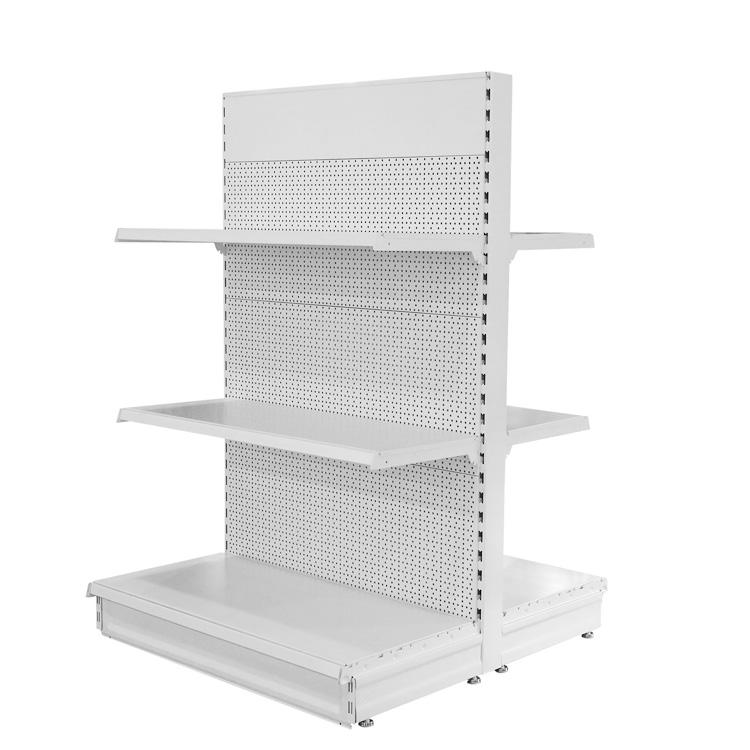
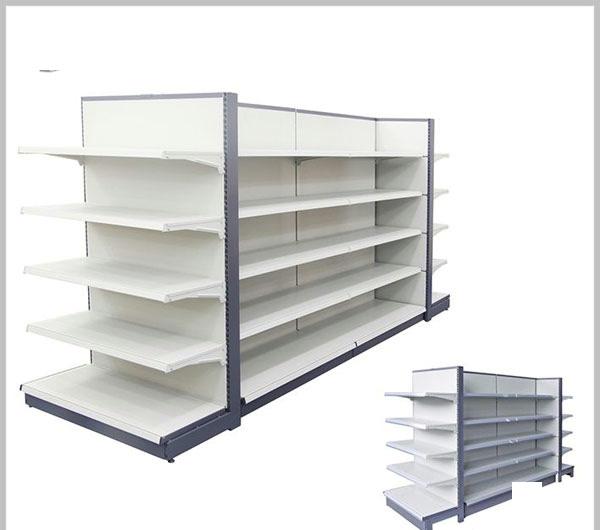
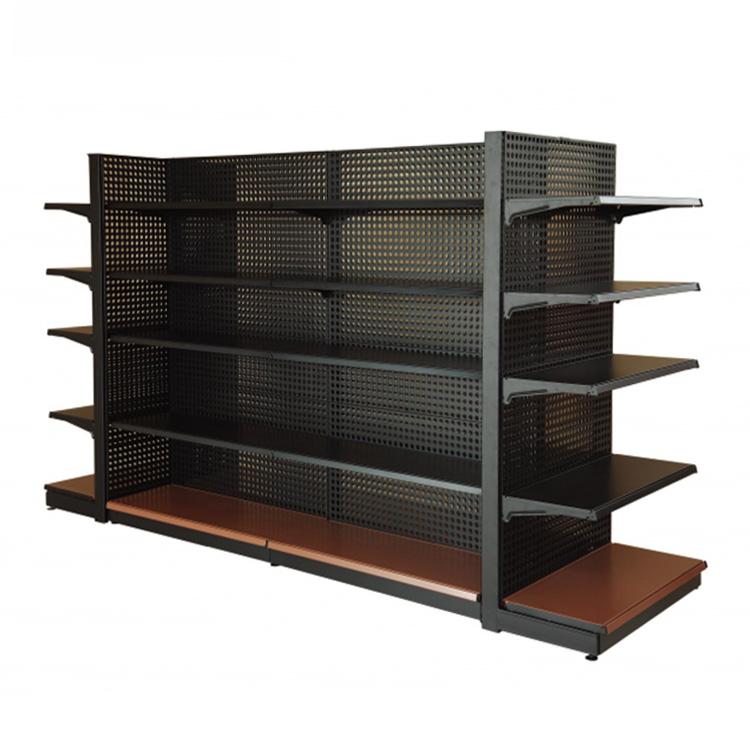
Gondola shelving is the freestanding retail fixture that forms a supermarket aisle. A single bay is a frame of two uprights, a base shelf and a set of adjustable shelves, finished with a back panel. Bays join together into runs, and runs form the aisles your customers walk.
The S50 system is a European-style gondola built from Q235B cold-rolled steel. Its name comes from the 50 mm pitch: shelf levels adjust in 50 mm steps up the upright, so a shelf can be re-pitched when the product mix changes — tall cereal boxes this season, short cans the next — without new parts. A load figure on a gondola is only meaningful when it is stated per shelf tier, for an evenly distributed load (UDL). The S50 is rated at 100–200 kg per shelf tier, UDL.
Three configurations cover almost every store layout, and they are worth telling apart before you order. Single-sided wall bays have shelves on one side only and stand against a wall — the perimeter of the store. Double-sided island bays have shelves on both sides and stand in the middle of the floor — the aisle itself, one bay serving two aisles at once. End cap bays are fitted to the end of a run, facing the cross-aisle — the promotional face of the aisle, where the store puts offers and seasonal lines. The same S50 uprights and shelves build all three. What changes between them is the arrangement, not the steel.
2. The sizes you can actually order
The table below is taken from the S50 product page on 2026-11-11. All dimensions are in millimetres. Load is per shelf tier, evenly distributed.
Three things in that table surprise most first-time buyers, and all three matter. First, the load is a range, not a single number. 100–200 kg per tier covers the S50 system as a whole. Where a given bay sits in that range depends on its exact configuration — length, depth, shelf span and upright section — so the load for your bay must be confirmed in the quotation. Do not order on "200 kg" alone, and do not assume every S50 bay carries the top of the range. Second, depth is a merchandising decision, not just a size. A 300 mm deep bay suits narrow aisles and small packaged goods; a 670 mm deep bay holds larger packs and more facings but needs a wider aisle and more reach from the customer. Measure the deepest product first, then pick the depth. Third, height is set by the store, not by the catalogue. The S50 runs from 1400 mm to 2400 mm high. A low bay keeps every shelf within easy reach; a tall bay adds selling space but puts the top shelf above comfortable reach for many customers. Pick the height from who shops the aisle and what sits on the top shelf — not from the maximum the system allows.
Remember the scope warning from the introduction: these are S50 figures. Other gondola models on this site have different sizes and loads, and their figures are stated on their own product pages and quotations.
| Parameter | S50 system range |
|---|---|
| Bay length | 665 / 900 / 1000 / 1250 / 1330 mm |
| Bay depth | 300 / 370 / 470 / 570 / 670 mm |
| Bay height | 1400–2400 mm |
| Upright section | 60 × 30 mm / 80 × 30 mm |
| Shelf adjustment pitch | 50 mm |
| Rated load per shelf tier | 100–200 kg (UDL) |
| Steel | Q235B cold-rolled steel |
| Configurations | Single-sided wall bay, double-sided island bay, end cap bay |
3. How to pick: four questions, in order
Question 1 — What is the heaviest thing on one shelf? Weigh the heaviest single load that will sit on one tier, then check it against the per-tier rating, not the total for the whole bay. A bay with several tiers at 100–200 kg each is not one big shelf: each tier must carry its own load, evenly spread. If the heaviest load is within 100–200 kg per tier and evenly distributed, the S50 covers it — but confirm the exact figure for your configuration in the quotation, because the rating is a range, not a promise of 200 kg on every bay. If the load is regularly above that range, you are no longer in gondola territory for that product: ask the factory what system that load belongs on, and do not put it on a retail fixture.
Question 2 — How wide is the largest package? The bay length must fit the products that will face on it, with room for the facings the store plan calls for. A 665 mm bay suits a short run or a narrow wall section. A 900 mm or 1000 mm bay is the workhorse length for a standard aisle. A 1250 mm or 1330 mm bay gives a long continuous run with fewer uprights breaking up the display — but remember Question 1: the extra length does not raise the per-tier rating, and the exact load for a long bay is confirmed in the quotation.
Question 3 — How many tiers do you actually need? More tiers are not always better. Each extra shelf adds selling space, but it also shrinks the clear height between shelves. Measure the tallest product that will sit on a tier, add room to lift it out by hand, and only then count tiers. The 50 mm pitch is what makes this practical: when the product mix changes, the shelves move in 50 mm steps instead of the bay being replaced. Decide the tier count from the tallest product, not from the number of shelves the catalogue photograph shows.
Question 4 — Single-sided, double-sided, or end cap — and how does the customer move? A wall bay and an island bay are not interchangeable. Wall bays line the perimeter and are shopped from one side. Island bays sit mid-floor and are shopped from both sides, so one bay serves two aisles — but it also needs aisle space on both sides. End caps face the cross-aisle and are the store's promotional face; they are planned last in the layout and stocked first in the promotion calendar. For the aisle widths, run lengths and circulation behind this decision, use the Supermarket Shelving Layout Guide rather than guessing from a single bay's dimensions. A bay that fits the product but blocks the aisle is a bay that costs sales.
4. Three mistakes buyers keep making
- Buying by total load: a bay's total load is the sum of its tiers, and it tells you nothing about one tier. One tier loaded above its 100–200 kg rating is overloaded, even if the other tiers are empty. Always ask: per tier, evenly distributed, for this exact configuration?
- Treating one model's numbers as the whole range: the S50's 100–200 kg per tier, 50 mm pitch and 665–1330 mm lengths belong to the S50. Other gondola models on this site have different specifications. Ordering a different model on S50 figures is how a bay arrives that does not match the store plan. Check the model on the product page, and the final figure on the quotation.
- Forgetting the quotation inputs: a reliable factory quotation needs the store plan or available wall and floor runs, the product categories and largest package sizes, the heaviest load per tier, the required bay length, depth, height and number of tiers, single- or double-sided, colour and finish, quantity, and the delivery destination. Send those things and the quotation comes back accurate; send only "I need some gondola shelving" and it comes back as a guess.
5. What to ask the factory before you order
- Store plan or available wall runs and floor area, with ceiling height
- Product categories and largest package sizes per aisle
- Heaviest load per shelf tier (kg), and is it evenly distributed?
- Required bay length, depth, height and number of tiers
- Single-sided wall bays, double-sided island bays, end caps — how many of each?
- Aisle widths and customer circulation
- Colour / finish required, and any branding
- Quantity, delivery destination, and FOB or CIF terms
Conclusion
Gondola shelving rewards buyers who plan the aisle first and the bay second. Pick the configuration from where the bay stands — wall, island or end cap. Pick the depth from the deepest product, the length from the facings the plan calls for, the tier count from the tallest product, and the rating from the heaviest load on a single tier — in that order. In the S50 system that rating is 100–200 kg per tier, UDL, with the exact figure for your bay confirmed in the quotation. And remember the scope: these are S50 figures. For any other model, the product page and the quotation govern.
Start with the S50 system below, or send your quotation inputs and get a factory layout and price within 24 hours.
Frequently Asked Questions
What is the load capacity of supermarket gondola shelving?
For the S50 system, 100–200 kg per shelf tier for an evenly distributed load. The exact figure for a given bay depends on its configuration and is confirmed in the quotation. Other gondola models have different ratings — check the model on its own product page.
What sizes does the S50 gondola system come in?
Bay lengths of 665, 900, 1000, 1250 and 1330 mm; depths of 300, 370, 470, 570 and 670 mm; heights from 1400 to 2400 mm; uprights of 60 × 30 mm or 80 × 30 mm. Other models have different size ranges.
What is the 50 mm pitch?
The shelf levels adjust in 50 mm steps up the upright, so shelf spacing can be re-set when the product mix changes, without new parts.
What is the difference between a single-sided and a double-sided gondola bay?
A single-sided bay has shelves on one side only and stands against a wall. A double-sided bay has shelves on both sides and stands mid-floor as an island, serving two aisles. End cap bays fit the end of a run, facing the cross-aisle.
Can I get a whole-store gondola layout and quotation?
Yes. Send the store plan, product categories and package sizes, heaviest load per tier, required bay sizes and quantities, and the delivery destination. The factory confirms the final specification in the approved drawing and quotation.
Related Products
Get a Free Layout Design & Quote
Send us your warehouse or store drawings — our engineers will reply within 24 hours with a tailored solution and factory-direct price.