Most buyers do not set out to buy "medium duty shelving". They set out to buy shelving that holds their stock, and then discover that light domestic racks are too weak and heavy pallet racking is far more than they need. Medium duty is the space in between: steel shelving built for regular warehouse and stockroom loads, picked by hand, without forklifts and without pallet positions. This guide explains what medium duty actually means, where it sits in Huaxiao Rack's range, and how to pick the load rating, bay size and shelf type for your stock. Every load figure below is a Huaxiao figure, taken from the product pages. Where a figure is a range, the article says so — do not order on the top of a range alone. For how to pick sizes on the light-duty side, see Slotted Angle Shelving Sizes Explained. For the full load-capacity rules — per-tier ratings, static versus on-wheels, and why a test value is not a rated value — see our Warehouse Shelving Load Capacity Guide.
Quick answer
Medium duty shelving is steel shelving for hand-loaded warehouse and stockroom stock, rated 100–500 kg per shelf tier for an evenly distributed load. It sits between light slotted angle shelving (100 kg per tier) and heavy-duty shelving (500–1,000 kg per tier). Pick the tier from the heaviest load on a single shelf, and confirm the exact figure for your configuration in the quotation — a range is not a promise of its top number.
| At a glance | Medium duty shelving |
|---|---|
| Rated load | 100–500 kg per shelf tier, evenly distributed (UDL) |
| Best for | Warehouse cartons, auto parts and spare parts, hardware store stock, retail backroom goods |
| Picking method | By hand, standing at the bay — not by forklift |
| Deck | Steel shelf panels |
| Minimum order | 50 sets (standard); 500+ units (custom OEM) |
| Production time | 12–22 days |
1. What "medium duty" actually means
Medium duty shelving is steel shelving for hand-loaded stock: cartons, parts, tools, retail backroom stock, archive boxes and workshop supplies. The picking unit is the parcel or the bin, picked by a person standing at the bay — not a pallet moved by a forklift. That one fact sets everything else: bay heights stay within comfortable reach, aisle widths are pedestrian widths, and the load that matters is the load on one shelf tier, evenly distributed.
It is worth saying what medium duty is not. It is not light domestic shelving, and it is not pallet racking. A light rack that holds 100 kg per tier will sag or fail under a bay of engine parts; a pallet rack built for tonnes per beam pair is wasted money and wasted floor space for a stockroom of cartons. Medium duty exists because most real stockrooms sit between those two extremes.
Competitor pages for this keyword usually publish a per-tier load table and a price range alongside it, and that is the right way to shop: compare per-tier ratings, bay sizes and deck types, not the biggest number on the box.
2. Huaxiao's four load tiers — the table to shop from
Before picking a medium duty bay, know where it sits in the range. Huaxiao's shelving falls into four load tiers, all rated per shelf tier. All four figures below are per shelf tier, for an evenly distributed load. A bay's total load is the sum of its tiers and tells you nothing about one tier on its own.
Medium duty is a range, not a single number. 100–500 kg per tier covers the whole medium duty range. Where a given bay sits in that range depends on its exact configuration — bay width, beam profile and deck — so the load for your bay must be confirmed in the quotation. Do not order on "500 kg" alone.
The tiers overlap on purpose. A 100 kg load can sit on a light rack or on a medium duty bay; the difference is what else the bay has to do — span, height, deck type, future growth. Pick the tier from the heaviest load and the hardest job, not from the lightest box.
Above 500 kg per tier, you are no longer in medium duty. If a single tier regularly carries more than 500 kg, that load belongs on the heavy duty range. Ordering a medium duty bay for a heavy duty load is how a shelf sags.
| Tier | Rated load per shelf tier | What it is for |
|---|---|---|
| Light slotted angle (standard) | 100 kg | Home storage, light retail stock, small parts |
| Modular boltless rivet | 100–150 kg | Stockrooms and workshops that need tool-free reconfiguration |
| Medium duty | 100–500 kg | Warehouse and stockroom cartons, parts, tools and retail backroom stock |
| Heavy duty | 500–1,000 kg | Heavy warehouse stock, dense parts and commercial storage |
3. Load by span: a 2000 mm bay is not rated like a 900 mm bay
The per-tier rating falls as the bay gets wider for the same steel — a longer beam bends more under the same load. That is why medium duty is a range (100–500 kg per tier), not one number: the same product line is rated differently at different spans, and the exact figure for your bay is confirmed in the quotation.
The one medium-duty bay on this site with a stated per-tier rating and full member sizes is the blue and white longspan bay: 2000 × 450 × 2000 mm, 4 tiers, rated 300 kg per level, with 40 × 80 × 1.0 mm columns, 40 × 60 × 1.0 mm beams and a 0.7 mm steel deck. Its 300 kg figure belongs to that bay at that span — do not copy it onto a narrower or wider bay. Every other bay in the medium-duty range carries the verified 100–500 kg per tier range, with the exact rating confirmed in the quotation.
| Bay | Size | Rated load per tier | What is verified |
|---|---|---|---|
| Blue and white longspan bay | 2000 × 450 × 2000 mm, 4 tiers | 300 kg | Stated rating with full member sizes: column 40 × 80 × 1.0 mm, beam 40 × 60 × 1.0 mm, deck 0.7 mm |
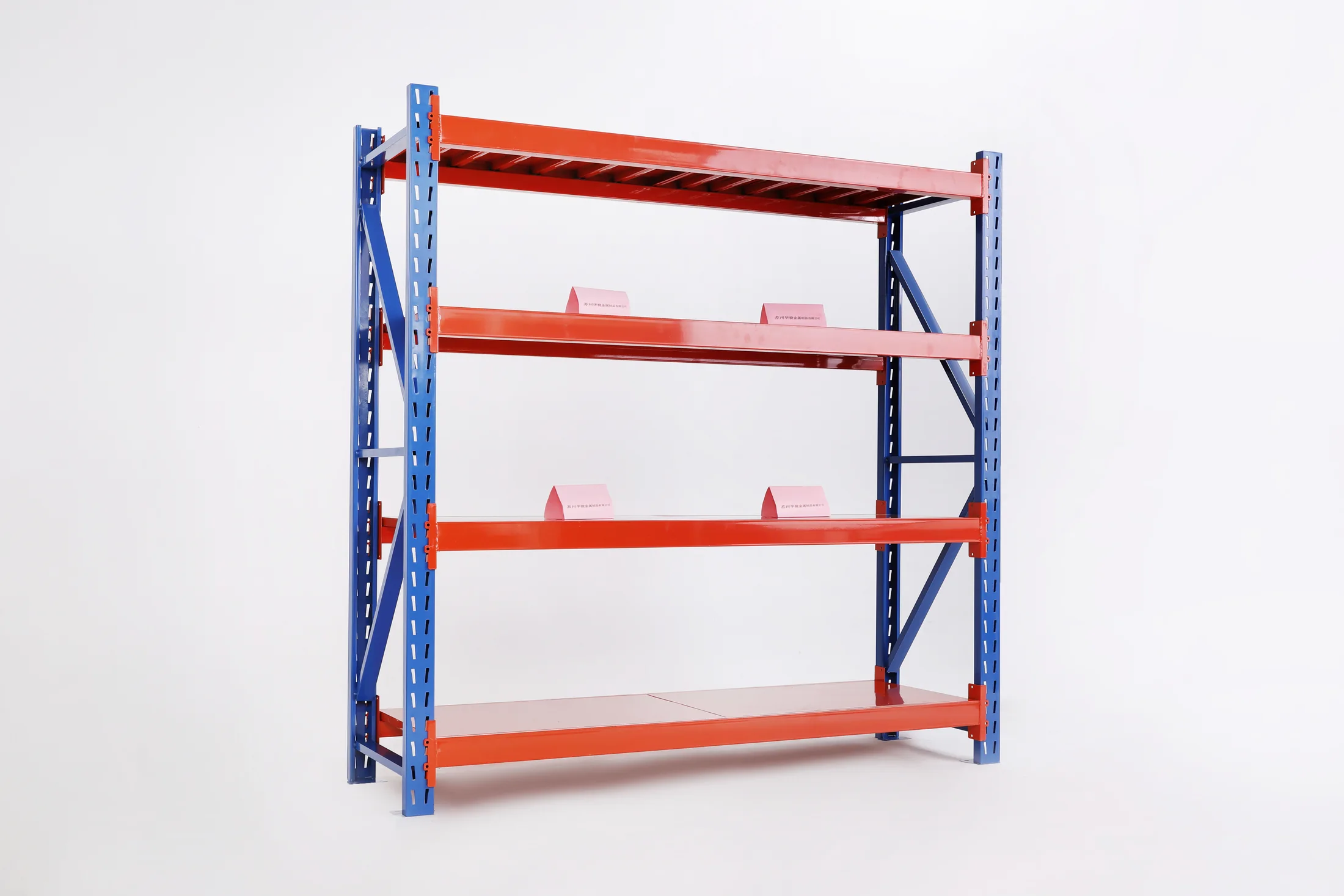
| Blue and orange medium-duty bay | Configured to order | 100–500 kg | Verified range for the whole medium-duty line; exact figure confirmed in the quotation |
4. UDL vs point load: the rating assumes the weight is spread evenly
Every load figure in this guide is a UDL rating — a uniformly distributed load, spread evenly across the whole shelf panel. A single heavy item sitting in the middle of one panel is a point load, and it loads the shelf differently: the same kilograms concentrated in one spot stress the panel and the beams more than the same kilograms spread out. A bay rated 300 kg per tier for a UDL is not automatically rated 300 kg for one item in the middle.
A bay's total load is the sum of its tiers and tells you nothing about one tier on its own. The worked example below uses the blue and white longspan bay, the only medium-duty bay on this site with a stated per-tier rating. The arithmetic is the same for any bay.
| Worked example — blue and white longspan bay | Figure |
|---|---|
| Bay size | 2000 × 450 × 2000 mm, 4 tiers |
| Rated load per tier (UDL) | 300 kg |
| Tiers | 4 |
| Total bay load (UDL) | 4 × 300 kg = 1,200 kg per bay |
| Overload check | One tier at 400 kg is overloaded, even if the other three tiers are empty |
5. How to pick: four questions, in order
Question 1 — What is the heaviest thing on one shelf? Weigh the heaviest single load that will sit on one tier, then check it against the per-tier rating, not the total for the whole bay. If the heaviest load is within 100–500 kg per tier and evenly spread, medium duty covers it — but confirm the exact figure for your configuration in the quotation, because the rating is a range. If the heaviest load is regularly above 500 kg per tier, ask the factory about the heavy duty range instead. If it is under 100 kg per tier and the stock is light, the slotted angle range may be the better buy — see the sizes guide for that decision.
Question 2 — How will the stock be picked? Medium duty shelving is hand-picking shelving. The picker stands at the bay and takes cartons or bins by hand, so the bay height and the aisle in front of it are set by a person, not a machine. Keep the top picking level within comfortable reach without a step, and keep the aisle wide enough for a person carrying a carton — or a trolley, if the stockroom uses one. If the operation moves full pallets by forklift, that is pallet racking, not medium duty shelving, and the bay design is different from the ground up.
Question 3 — How many tiers, and how tall is the tallest product? More tiers are not always better. Each extra shelf adds selling or storage space, but it also shrinks the clear height between shelves. Measure the tallest product that will sit on a tier, add room to lift it out by hand, and only then count tiers. Medium duty bays adjust shelf levels, so the tier count can follow the product mix rather than the catalogue photograph — but the count is decided by the tallest product, not by how many shelves fit in the frame. And remember Question 1: adding tiers does not raise the per-tier rating.
Question 4 — Steel deck or another deck type? Huaxiao's medium duty bays use steel shelf decks. A steel deck suits warehouse stock — cartons, parts, tools — because it does not warp, it cleans easily, and it carries the rated load across the full span of the shelf. When you compare suppliers, ask what the deck is made of and whether the quoted load rating applies to that deck: a rating achieved on one deck material does not automatically transfer to another. If a supplier quotes a load without naming the deck, the number is not comparable.
6. Three mistakes buyers keep making
- Buying by total load: a bay's total load is the sum of its tiers. One tier loaded above its 100–500 kg rating is overloaded, even if the other tiers are empty. Always ask: per tier, evenly distributed, for this exact configuration?
- Ordering on the top of the range: "100–500 kg" does not mean every medium duty bay carries 500 kg per tier. The exact figure depends on bay width, beam profile and deck, and it is confirmed in the quotation. Ordering on "500 kg" and receiving a bay rated lower for its configuration is the most common medium duty disappointment.
- Picking the tier from the average box: shelving is bought for the heaviest load it will ever carry, not the average one. If one product line in the stockroom weighs 400 kg per tier and everything else weighs 80 kg, the bay is a 400 kg bay. Size for the heaviest tier, then check the rest fits.
7. What to ask the factory before you order
- Heaviest load per shelf tier (kg), and is it evenly distributed?
- Product types and largest carton or bin sizes per bay
- Required bay width, depth, height and number of tiers
- Picking method: by hand, with a trolley, or by forklift?
- Deck type required (Huaxiao medium duty uses steel decks)
- Colour / finish required
- Quantity, delivery destination, and FOB or CIF terms
Conclusion
Medium duty shelving is the right answer when the stock is too heavy for a light rack and too small for pallet racking: hand-picked cartons, parts and tools, stored on steel decks, at heights a person can reach. Pick the tier from the heaviest load on a single shelf — in Huaxiao's range that is 100–500 kg per tier for medium duty, 100 kg for standard slotted angle, 100–150 kg for modular boltless, and 500–1,000 kg for heavy duty. Pick the tier count from the tallest product, the bay size from the largest carton, and the deck from what the stock does to it. And confirm the exact per-tier figure for your configuration in the quotation, because a range is not a promise of its top number.
Start with the medium duty bay below, or send your quotation inputs and get a factory layout and price.
Frequently Asked Questions
What is medium duty shelving?
Steel shelving for hand-loaded warehouse and stockroom stock — cartons, parts, tools and retail backroom goods — picked by a person standing at the bay, not by forklift. In Huaxiao's range it is rated 100–500 kg per shelf tier.
How much weight can medium duty shelving hold per shelf?
Huaxiao's medium duty range is rated 100–500 kg per shelf tier, evenly distributed. The exact figure for a given bay depends on its configuration and is confirmed in the quotation. Do not order on the top of the range alone.
What is the difference between medium duty and heavy duty shelving?
Medium duty is rated 100–500 kg per tier and built for hand-picked stock. Heavy duty is rated 500–1,000 kg per tier for heavier warehouse stock. If a single tier regularly carries more than 500 kg, it belongs on the heavy duty range.
What is the difference between medium duty and slotted angle shelving?
Slotted angle is the light end of the range: the standard version is rated 100 kg per tier and the modular boltless version 100–150 kg per tier. Medium duty starts where those leave off and runs to 500 kg per tier, with heavier beams and steel decks.
What deck type does Huaxiao's medium duty shelving use?
Steel shelf decks. When comparing suppliers, ask what deck the quoted load rating applies to — a rating on one deck material does not automatically transfer to another.
How do I know if I need medium duty instead of slotted angle shelving?
Weigh the heaviest single load on one shelf. If it is regularly above 100 kg per level, slotted angle is not enough — the standard version is rated 100 kg and the modular version 100–150 kg per level. Medium duty starts at 100 kg and runs to 500 kg per tier, with heavier beams and steel decks. Pick the tier from the heaviest load, not from the lightest box.
What is the minimum order and lead time for medium duty shelving?
Minimum order is 50 sets for standard units (500+ units for custom OEM), and production time is 12–22 days. The exact price for your bays depends on size, tier count, load rating and finish, and is confirmed in the quotation.
Related Products
Get a Free Layout Design & Quote
Send us your warehouse or store drawings — our engineers will reply within 24 hours with a tailored solution and factory-direct price.