A hardware, tool and machinery store is two shops in one. The first shop sells: small hand tools, screws, fittings and parts must be visible, labelled and easy to reach, or the customer walks past them. The second shop stores: bulk cartons, power tools and full toolboxes must sit on shelves that are actually rated for their weight, or the shelf sags and the stock is damaged. This guide was written after a hardware store owner in India asked us for display and storage racking for his shop. It shows how Huaxiao's three shelving ranges — slotted angle, medium duty and supermarket gondola — fit together in a tool store, with three working setups you can copy bay for bay. Every load figure below is a Huaxiao figure, taken from the product pages. Prices are category starting prices only; the exact price for your bays is confirmed in the quotation. For the light-duty sizes in detail, see Slotted Angle Shelving Sizes Explained. For how to pick load, bay size and shelf type on the heavier side, see Medium Duty Shelving Explained.
1. Two jobs in one bay: display and storage
Display and storage pull in opposite directions. Display wants the product at eye level, facing the customer, with a price on it. Storage wants the heaviest load low down, out of the way, on a shelf that can carry it. A hardware store needs both from the same bays, so plan each tier by what sits on it — not by the catalogue photograph.
Two rules decide the layout: display what sells, store what weighs. Hand tools, small parts and fast-moving consumables go where the customer can see and reach them. Full toolboxes, bulk cartons and power tools go on the lower tiers, where their weight is safe and the customer can still lift them out. One tier, one job. A tier that holds hanging hand tools should not also carry a stack of bulk cartons. When each tier has a single product type, the customer finds things faster, the staff restocks faster, and the load on every tier is easy to check against its rating.
Prices are category starting prices per set; the exact price depends on size, tiers, load and finish and is confirmed in the quotation. Minimum order is 50 sets.
| Setup | Best for | Rated load per shelf tier | Price from (per set) |
|---|---|---|---|
| Black slotted angle bay + pegboard back | Small hand tools and parts bins on the wall | 100 kg | $12.5 |
| Blue wide medium duty bay, side diagonal bracing | Power tools and bulk hardware | 100–500 kg | $25 |
| Grey double-sided gondola island, 2 bays in a run | Island display with many SKUs | 100–200 kg (S50) | $23 |
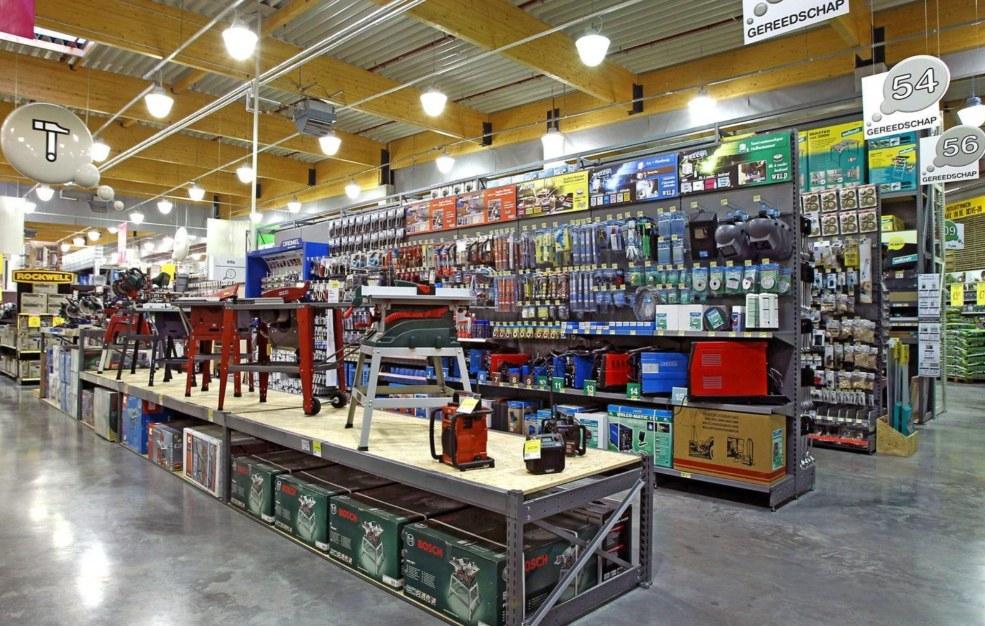
2. Setup 1 — Black slotted angle bay with a pegboard back: the hand-tool wall
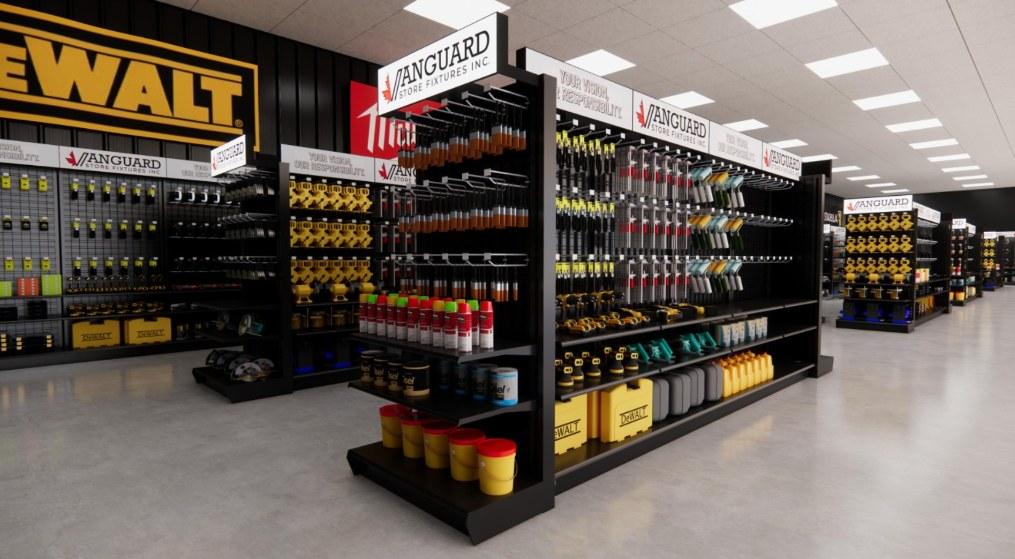
This is the small hand-tool wall of the hardware store. A black slotted angle bay with a pegboard back panel: hang wrenches, hammers, screwdrivers and pliers on hooks on the pegboard, so the customer sees the shape of every tool at a glance. Put parts bins on the shelf tiers. Put toolboxes on the bottom tier, where their weight sits low and they can be lifted out without reaching overhead.
Standard slotted angle is rated 100 kg per tier, which covers hand tools and parts bins comfortably. Put this bay against the shop wall, near the counter, where customers browse while they wait. If the tool range grows, add bays along the same wall — the modular boltless version, rated 100–150 kg per tier, reconfigures without tools when the product mix changes.
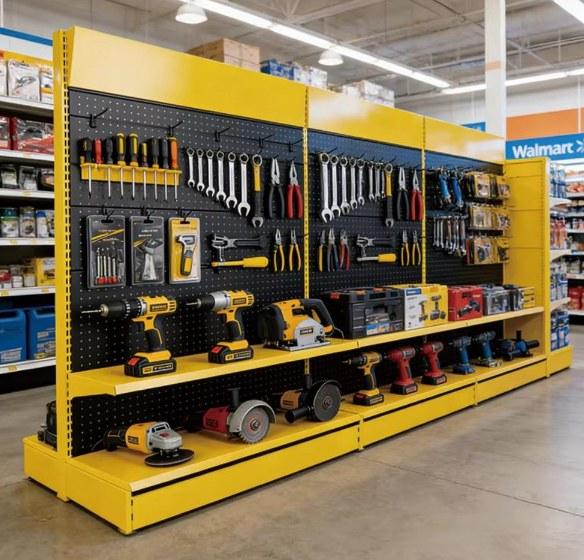
3. Setup 2 — Blue wide medium duty bay with side diagonal bracing: the heavy end
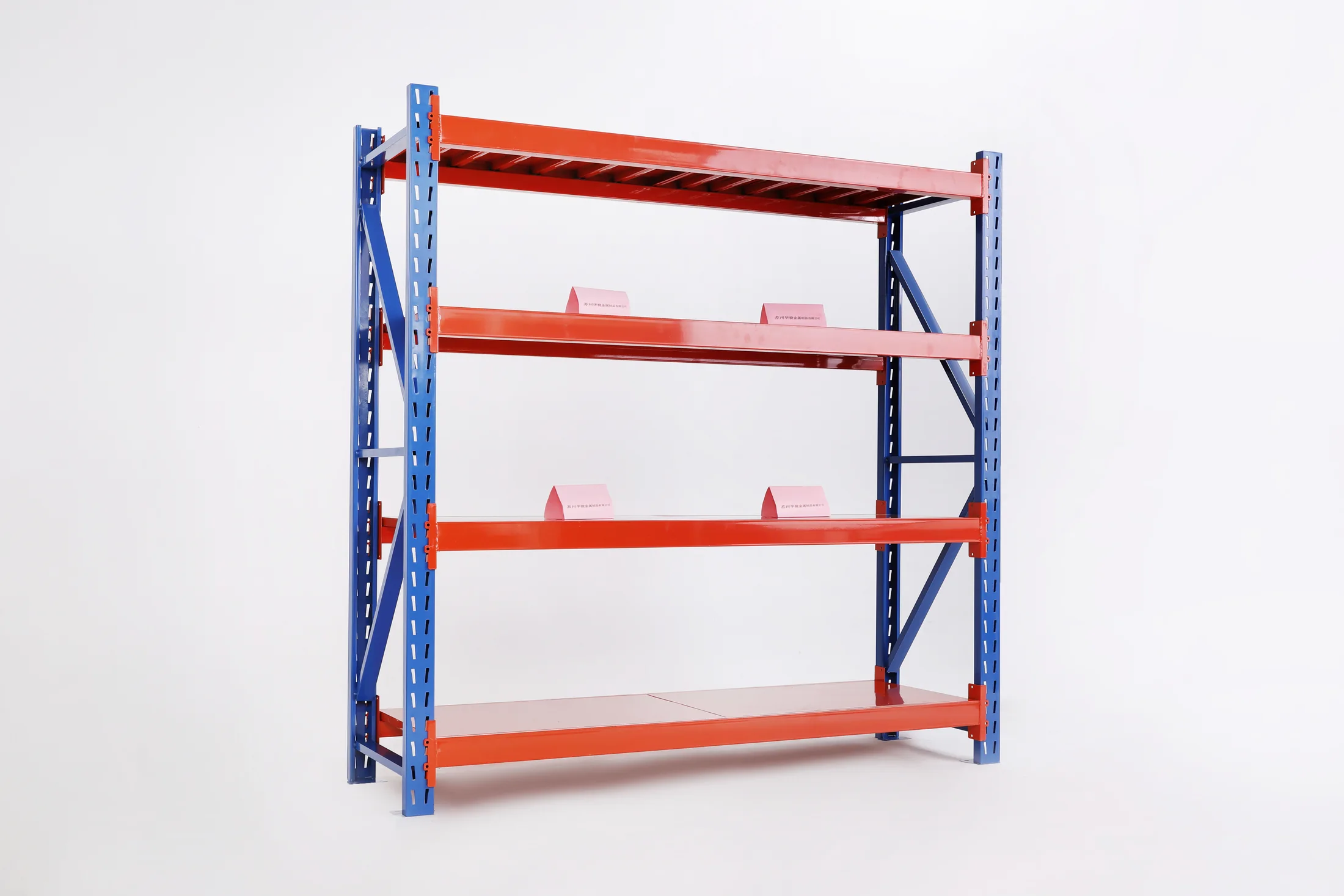
This bay takes the weight the hand-tool wall cannot. A blue wide medium duty bay with side diagonal bracing: parts bins on the top tier, hand tools on hooks on the upper tiers, power drills on the middle tier, and large toolboxes on the bottom two tiers. The diagonal bracing keeps the wide bay rigid under load.
Medium duty is rated 100–500 kg per tier. The exact figure for your bay depends on its configuration and is confirmed in the quotation — do not order on "500 kg" alone. Put this bay at the back of the shop or in the stock area behind the counter, where bulk hardware and power tools are picked. It is also the right bay for bulk hardware cartons: heavy, dense, and bought in quantity.
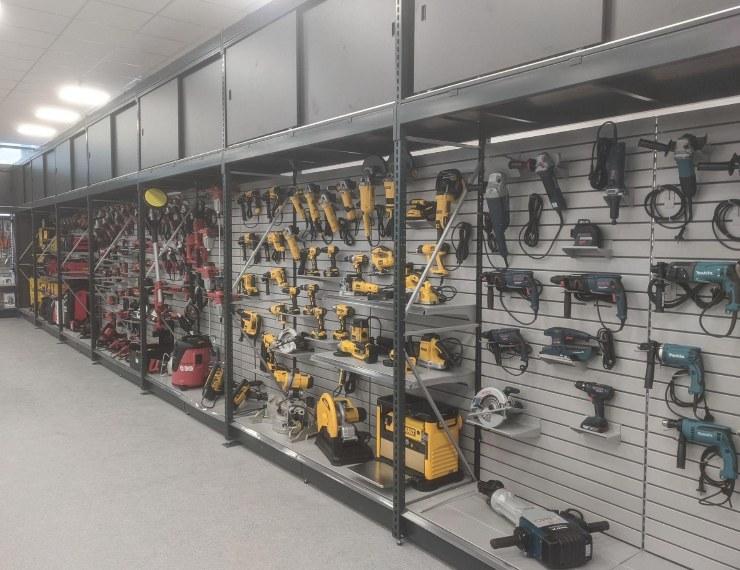
4. Setup 3 — Grey double-sided gondola island, two bays in a run: the shop floor
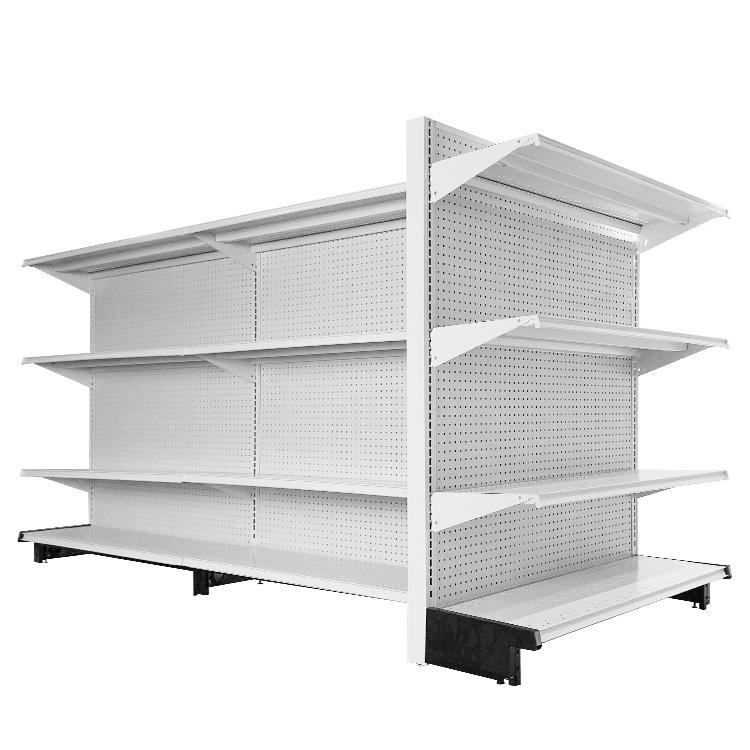
This is the island display for the middle of the shop floor, where the customer walks around it and sees the whole range. A grey double-sided gondola island, two bays joined in a run: power drills on the top tier, hammers, wrenches and pliers on the second tier, screwdrivers and tape measures on the third tier, a toolbox in the middle, screws and small-parts bins below that, and gloves and tape on the bottom tier. Every shelf edge carries a ticket rail, so the price is visible without asking.
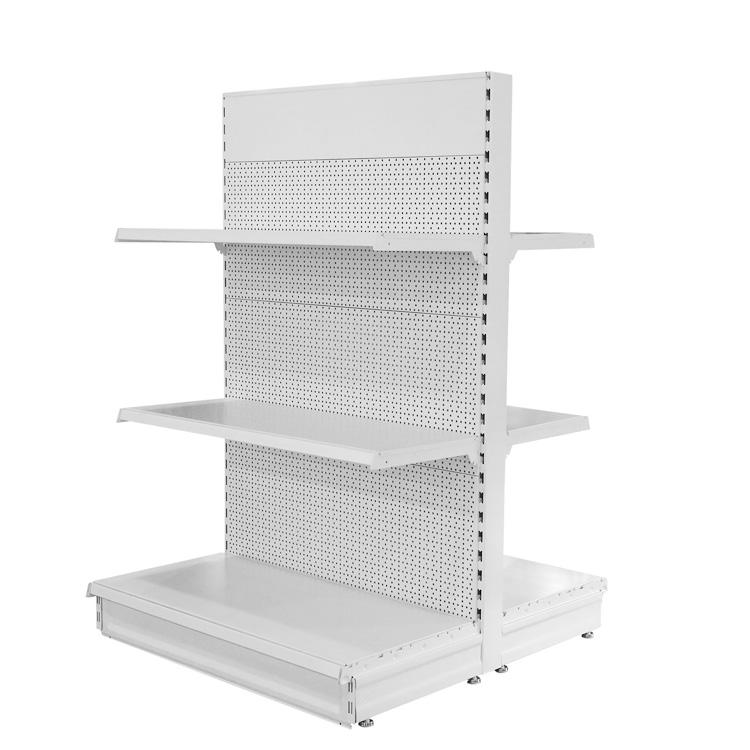
The S50 gondola system is rated 100–200 kg per tier. The island works because a customer standing at one end can see every product group at once — drills at the top, hand tools in the middle, consumables at the bottom. That is what an island is for: many SKUs, one glance. Keep the aisle around the island clear so two customers can pass and pick at the same time.
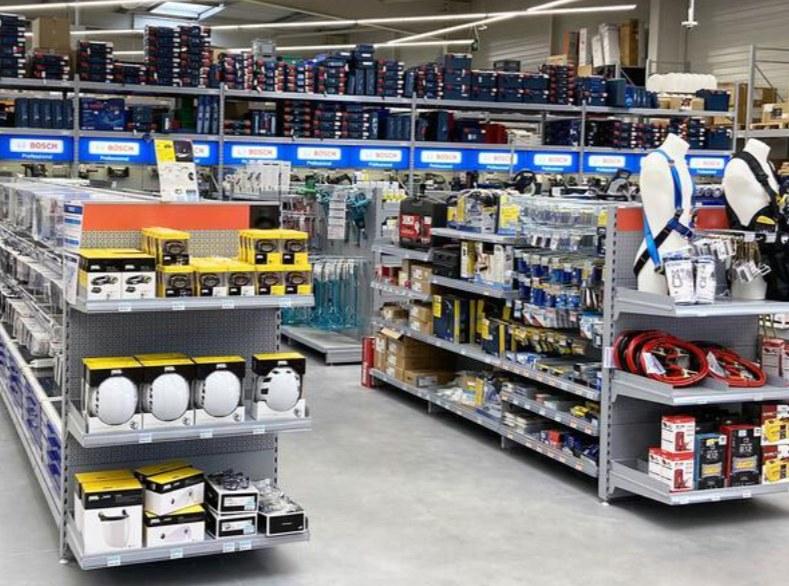
5. Match the shelf to the product, not the other way round
Huaxiao's shelving falls into load tiers, all rated per shelf tier for an evenly distributed load. The heaviest single item on one tier decides the tier. A power drill with its case, a full toolbox, a carton of bulk screws — weigh the heaviest tier, not the average box. Shelving is bought for the heaviest load it will ever carry.
Two warnings from the medium duty guide apply here too. First, a range is not a promise of its top number: "100–500 kg" does not mean every medium duty bay carries 500 kg per tier. The exact figure depends on bay width, beam profile and deck, and it is confirmed in the quotation. Second, a bay's total load is the sum of its tiers and tells you nothing about one tier on its own. One tier loaded above its rating is overloaded, even if the other tiers are empty.
On price: the three setups above start at $12.5 per set (slotted angle), $25 per set (medium duty warehouse range) and $23 per set (S50 gondola range), with a minimum order of 50 sets. Those are category starting prices. The final price for your bays depends on size, tier count, load rating and finish, and is confirmed in the quotation.
- Standard slotted angle: 100 kg per tier — hand tools, small parts, light retail stock.
- Modular boltless rivet: 100–150 kg per tier — stockrooms and workshops that reconfigure often.
- Medium duty: 100–500 kg per tier — power tools, bulk hardware, warehouse and stockroom stock.
- Heavy duty: 500–1,000 kg per tier — heavy warehouse stock and dense parts.
- S50 gondola system: 100–200 kg per tier — supermarket and retail island display.
6. Display rules that sell tools
Assembly is shown in our 35-second installation video — watch it below, and check the bay going up step by step before you order. The video's on-screen load figure is 100 kg per tier.
- Best sellers at eye level. The tools that sell every day go where the customer's eyes land first. Slow lines go low or high.
- Hang hand tools where their shape shows. Pegboard and hooks beat a shelf for wrenches, pliers, hammers and screwdrivers. Customers buy tools by sight — if they cannot see the shape, they do not pick it up.
- One bin, one part. Parts bins need dividers and labels. A bin of mixed screws is a bin nobody opens.
- A price on every shelf edge. Ticket rails on the shelf edges mean the customer does not have to ask. If the price is not visible, the tool stays on the shelf.
- Heavy tools low, light tools high. Full toolboxes and power tools sit on the bottom tiers. Parts bins and light hand tools sit higher. Nobody should lift a full toolbox down from above shoulder height.
- Count tiers from the tallest product. Measure the tallest product that will sit on a tier, add room to lift it out by hand, and only then count tiers. Adding tiers does not raise the per-tier rating.
- Keep the aisle clear. An island bay needs a clear aisle around it. If customers cannot pass each other in front of the bay, they will not stop at it.
Watch it in action
See the installation on video
The 35-second installation on a real bay — watch it on our YouTube channel, no account needed.
7. What to send the factory for an instant quote
Send these six things and the factory can return a layout drawing and a price without going back and forth. Send the floor plan and the load figures first if you are in a hurry. With those two, the factory can size the bays and price them; the rest can follow.
- Shop floor plan or layout drawing. A simple sketch with measurements is enough: where the door, counter, windows and walls are, and where the shelving goes. This is the single most important item — without a floor plan, the bay sizes have to be guessed, and that is what delays a quote.
- Bay sizes required. Width, depth, height and number of tiers per bay — or the wall length and run length available, if you want the factory to work out the bay count.
- Load per tier. The heaviest product on one shelf, in kg. One number per tier type is enough: hand tools, power tools, toolboxes, bulk cartons.
- Product list. What goes on each tier — hand tools, power tools, parts bins, toolboxes, machinery spares. Photos of the products help the factory place them on the right tiers.
- Quantity. How many bays, and whether they run as single bays or joined runs.
- Delivery destination and finish. City and country, so freight and terms can be quoted; colour or finish if it matters — for example black for the tool wall, grey for the island.
8. Three mistakes buyers keep making
Mistake 1: Buying by total load. A bay's total load is the sum of its tiers. One tier loaded above its rating is overloaded, even if the other tiers are empty. Always ask: per tier, evenly distributed, for this exact configuration?
Mistake 2: Ordering on the top of the range. "100–500 kg" does not mean every medium duty bay carries 500 kg per tier, and "100–200 kg" does not mean every S50 bay carries 200 kg per tier. The exact figure is confirmed in the quotation. Ordering on the top number and receiving a bay rated lower for its configuration is the most common disappointment.
Mistake 3: Sending no floor plan. A quote without a floor plan is a guess at bay sizes. Bays that do not fit the wall, block the door, or leave no aisle in front of the island cost more to fix than the drawing costs to make. Sketch the shop, mark the measurements, and send it with the enquiry.
Conclusion
A hardware, tool and machinery store needs three kinds of bay, not one: a pegboard slotted angle wall for hand tools and parts bins at 100 kg per tier; a braced medium duty bay for power tools and toolboxes at 100–500 kg per tier; and a double-sided gondola island for high-SKU display at 100–200 kg per tier. Plan each tier by the product on it, put the heaviest load on the lowest tier, and send the floor plan and load figures with your enquiry so the factory can quote the real bays instead of guessing them.
Start with the three bays below — the 5-tier slotted angle bay, the 100–500 kg blue-orange medium duty rack and the S50 gondola system — or send your floor plan and product list and get a factory layout and price.
Frequently Asked Questions
What shelving is best for a hardware store?
A mix of three: a pegboard slotted angle wall for hand tools and parts bins, a medium duty bay for power tools and toolboxes, and a double-sided gondola island for high-SKU display. One type alone cannot do all three jobs — the hand-tool wall, the heavy bay and the island each carry a different kind of weight.
How much weight can each shelf hold?
In Huaxiao's range: standard slotted angle 100 kg per tier, modular boltless 100–150 kg per tier, medium duty 100–500 kg per tier, heavy duty 500–1,000 kg per tier, and the S50 gondola system 100–200 kg per tier. All figures are per shelf tier, evenly distributed. The exact figure for your bay is confirmed in the quotation.
Can I change the shelf heights later?
Yes. Shelf levels are adjustable, so the tier spacing can follow the product mix. The modular boltless bays reconfigure without tools, which suits a store whose range changes often.
What do I need to send for a quotation?
Six things: a shop floor plan or layout drawing with measurements, the bay sizes (or the wall and run lengths available), the heaviest load per tier in kg, a product list of what goes on each tier, the quantity of bays, and the delivery destination. The floor plan and the load figures are the two that matter most — with those, the factory can size and price the bays without guessing.
What is the minimum order, and do you ship to India?
The minimum order is 50 sets. Delivery destination, freight and terms are confirmed in the quotation — send the city and country with your enquiry and the factory will quote accordingly.
Related Products
Get a Free Layout Design & Quote
Send us your warehouse or store drawings — our engineers will reply within 24 hours with a tailored solution and factory-direct price.