A buyer comparing boltless vs slotted angle shelving usually asks one question: which one holds more? The honest answer is that the name does not decide the load. \"Slotted angle\" is used two ways — for the shape of the upright, and for an old bolted way of joining it — and until that confusion is cleared up, no comparison makes sense. This guide clears it up first, then compares the two structures head to head: the traditional bolted angle-steel bay against the boltless rivet bay. Every Huaxiao figure below is taken from the live product pages. Figures published by other suppliers are labelled as theirs. For the full explanation of the names and why load figures disagree across suppliers, see Boltless Slotted Angle Shelving Explained. For how to pick width, depth, tiers and load bay by bay, see Slotted Angle Shelving Sizes Explained.
Quick answer
\"Slotted angle\" describes the upright — angle steel with slots punched at intervals. \"Boltless\" describes the joint — beams drop into the slots and lock under load, with no bolts. Huaxiao's angle-steel products are slotted angle uprights with boltless joints: the name says what the upright is, not how it is joined. The old structure this guide compares against is different: the same kind of angle steel, but joined with nuts, bolts and corner plates, tightened one joint at a time with a spanner.
Which holds more is decided by the steel, the beam profile, the bay width and how the figure was measured — not by which of the two names is on the page. Huaxiao's boltless range is rated 100 kg per shelf level for the standard bay and 100–150 kg per level for the modular boltless rivet system, both per level, evenly distributed. Huaxiao does not sell the old bolted structure and does not publish a rating for it. The bolted figures quoted in section 3 are what other suppliers publish for their own bolted bays, labelled as theirs, and they overlap the boltless range — which is the point: the joint alone does not put a bay in a higher load class.
| At a glance | Traditional bolted angle steel | Boltless rivet shelving |
|---|---|---|
| Upright | Angle steel, holes punched for bolts | Angle steel, slots punched at intervals |
| Joint | Nuts, bolts and corner plates, tightened with a spanner | Rivet heads on the beams seat into keyhole slots, tapped home with a rubber mallet |
| Tools to assemble | Spanner set (and a second pair of hands helps) | Rubber mallet and a level |
| Rated load per shelf level | No Huaxiao rating — Huaxiao does not sell this structure; competitor-published bolted figures run about 45–180 kg per level (see section 3) | Standard 100 kg; modular boltless rivet system 100–150 kg |
| Re-pitching a shelf level | Unbolt, move, re-bolt every joint on that level | Lift the beams out and drop them into another slot — no tools |
| Price from (per set) | No Huaxiao price — not sold | Slotted angle from $12.5 per set; warehouse shelving from $25.0 per set |
| Best for | A bay that is built once and never moved | Stockrooms that reconfigure, multi-bay runs, and anyone who wants to skip the spanner |
1. First, clear up the name: two uses of \"slotted angle\"
The phrase \"slotted angle\" is used two ways, and suppliers switch between them without saying so. In the first use it describes the shape of the upright: angle steel with slots punched at regular intervals. That is the upright Huaxiao sells — and Huaxiao's bays join those uprights without bolts, so the full name of the system is boltless slotted angle shelving. In the second use it describes an old structure: the same kind of angle steel, joined with nuts and bolts through the slots, one joint at a time. Same steel, same word, two different bays.
That is why a search for \"boltless vs slotted angle shelving\" returns contradictory advice. Some pages compare two names for one system; others compare two structures. This guide is the second kind: the traditional bolted angle-steel bay against the boltless rivet bay. The naming question in full — why boltless, slotted angle, rivet and keyhole are names for the same system, and why five suppliers give five different load numbers — is answered in Boltless Slotted Angle Shelving Explained, and it is not repeated here.
2. How each structure goes together
The bolted bay is assembled the slow way. Four angle-steel uprights, beams, shelf panels, and a bag of nuts, bolts and corner plates. Each joint is a bolt through a slot, a corner plate, a nut, and a spanner — tightened one joint at a time, and re-tightened later if a joint works loose. A five-tier bay has dozens of joints, so assembly is measured in hours, and it is a two-person job: one person holds the upright plumb while the other tightens.
The boltless bay is assembled the fast way. The same four uprights, but the beams carry rivet heads that seat into keyhole slots in the uprights. Drop the beam in, tap it home with a rubber mallet, and the joint locks under load — no bolts, no nuts, no spanner. Our 35-second installation video shows the whole sequence on a real bay — watch it below before you order. The video's on-screen load figure is 100 kg per tier, matching the standard rating.
The difference is not only speed. A bolted joint can work loose over time and needs checking; a rivet joint seats tighter as the load on it grows. And a bolted bay that needs a different shelf height has to be partly unbolted; a boltless bay just has its beams lifted out and dropped into another slot. Section 3 puts the two side by side.
Watch it in action
See the installation on video
The 35-second installation on a real bay — watch it on our YouTube channel, no account needed.
3. Head-to-head: bolted angle steel vs boltless rivet
Six rows decide the comparison: installation, load, maintenance, re-pitching, price and use case. Read the load row with care — it is the row where supplier figures disagree most, and the disagreement is about measurement, not about the joint.
On load, the honest statement is this: no joint type guarantees a load class. Huaxiao's boltless range is rated 100 kg per level (standard) and 100–150 kg per level (modular rivet system), per level, evenly distributed, with the exact figure for your configuration confirmed in the quotation. Huaxiao does not sell the bolted structure, so there is no Huaxiao bolted figure to put next to it. What other suppliers publish for their own bolted bays: Aceally publishes rivet shelving at 135–270 kg per level against slotted angle at 45–160 kg per level, and Morris Storage in the UAE publishes bolt-free shelving at 150–1,000 kg per level against slotted angle at 75–180 kg per level. Those are Aceally's and Morris Storage's own published figures, quoted here only to show that the bolted side is published across a wide range that overlaps the boltless range — they are not Huaxiao figures and not a general fact about bolted bays. A supplier that publishes a high number for one bay is publishing a number for that bay's steel, beam profile and width, not for the joint type.
On price, the same honesty applies. Slotted angle starts at $12.5 per set and warehouse shelving from $25 per set, per set, minimum order 50 sets, with the final price confirmed in the quotation. There is no Huaxiao price for a bolted bay because there is no bolted bay to sell. A bolted bay's lower material cost — fewer formed parts, plain bolts — is real, but it is paid back in assembly time: hours with a spanner against minutes with a mallet, and every re-pitch costs the same hours again.
| Traditional bolted angle steel | Boltless rivet shelving | |
|---|---|---|
| Installation | Hours; spanner set; two people; dozens of nuts and bolts | Minutes; rubber mallet and a level; beams drop into keyhole slots and lock under load |
| Rated load per shelf level | No Huaxiao rating; competitor-published bolted figures run about 45–180 kg per level (Aceally 45–160 kg, Morris Storage 75–180 kg — their own figures) | Standard 100 kg; modular boltless rivet system 100–150 kg, per level, evenly distributed |
| Maintenance | Joints can work loose; check and re-tighten bolts | Rivet joints seat tighter under load; check that every rivet is fully seated |
| Re-pitching a level | Unbolt, move, re-bolt every joint on that level | Lift the beams out and drop them into another slot — no tools |
| Price | Lower material cost, higher assembly cost; no Huaxiao price (not sold) | Slotted angle from $12.5 per set; warehouse shelving from $25.0 per set; MOQ 50 sets |
| Use case | A bay built once and never moved or re-pitched | Stockrooms that reconfigure, continuous multi-bay runs, fast fit-outs |
4. How to choose: three scenarios
Choose by what the bay has to do after it is built, not by the name on the page. Three scenarios cover most buyers.
A fixed archive or back room that will not change: if the bay is built once, loaded once, and never moved or re-pitched, the bolted structure's slow assembly is paid once and then forgotten — but check the supplier's per-level rating for your exact bay size before ordering, and remember every future change costs another round with the spanner. If the bay will ever be re-pitched, the boltless bay is the cheaper bay over its life even before the assembly time is counted.
A warehouse or stockroom that reconfigures: pick the boltless rivet bay. Shelf levels move without tools, bays run as continuous starter and add-on runs along a wall, and the modular system at 100–150 kg per level covers heavier stock without stepping up to medium duty. This is the buyer Huaxiao's boltless range is built for.
Budget first, and the load is light: compare the per-set price for the same bay size and tier count, then add the assembly cost. A bolted bay can look cheaper per set and cost more once two people spend hours assembling it — and more again at the first re-pitch. For light loads (cartons, parts, retail stockroom storage), the standard boltless bay at 100 kg per level, from $12.5 per set, is the usual answer; for anything above 150 kg per level, neither structure is the right one — step up to medium duty at 100–500 kg per level.
5. What Huaxiao sells: boltless, in two configurations
Huaxiao sells the boltless side of this comparison, in two configurations. The standard slotted angle bay is rated 100 kg per shelf level, in 3, 4, 5 or 6 tiers, for cartons, parts, tools and retail stockroom storage. The modular boltless rivet system is rated 100–150 kg per shelf level, with thicker shelf panels, running as continuous starter and add-on bays for stockrooms that reconfigure often. Both are angle-steel uprights with boltless joints — the naming is explained in full in Boltless Slotted Angle Shelving Explained, and the sizes in Slotted Angle Shelving Sizes Explained.
Above 150 kg per level, the answer is not a different joint — it is a heavier range: medium duty at 100–500 kg per level, then heavy duty at 500–1,000 kg per level. Factory terms for the boltless range: minimum order 50 sets, production time 12–22 days, FOB/CIF, black powder coat or customised colour. Custom sizes, tier counts and finishes are made to order, and the final specification is stated in the approved drawing and quotation — not in a catalogue line.
Conclusion
Boltless vs slotted angle is two questions, not one. As names, they describe two parts of the same bay — the slotted angle upright and the boltless joint — and Huaxiao's range is both at once. As structures, the choice is between a bolted bay that is slow to build and slow to change, and a boltless rivet bay that goes up in minutes and re-pitches without tools. The load is decided by the steel, the beam profile, the bay width and how the figure was measured, not by the joint: Huaxiao's boltless range is rated 100 kg per level standard and 100–150 kg per level modular, per level, evenly distributed. Pick by the heaviest thing on one level and by how often the bay will change, confirm the exact figure for your configuration in the quotation, and watch the 35-second installation before you order.
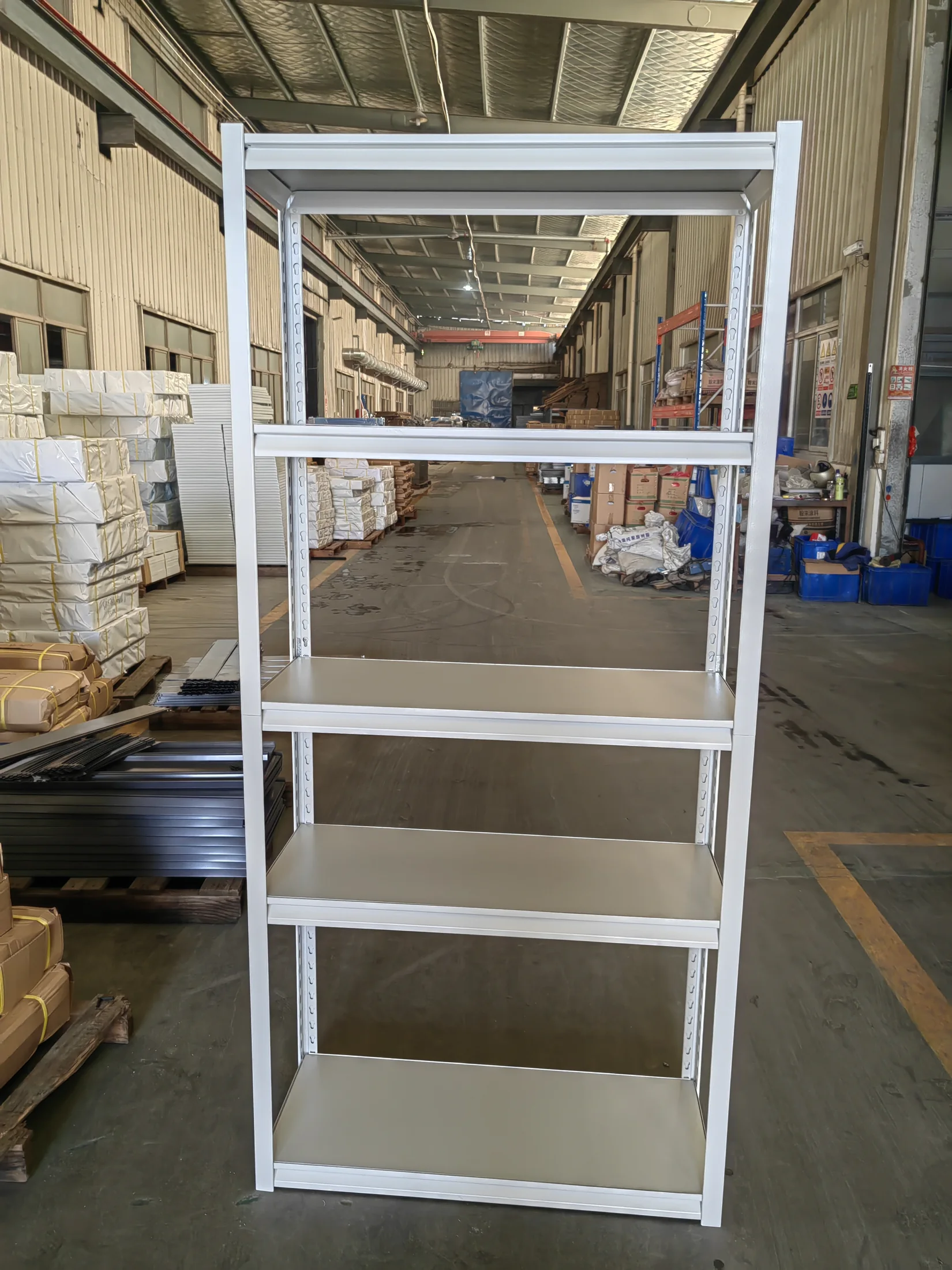
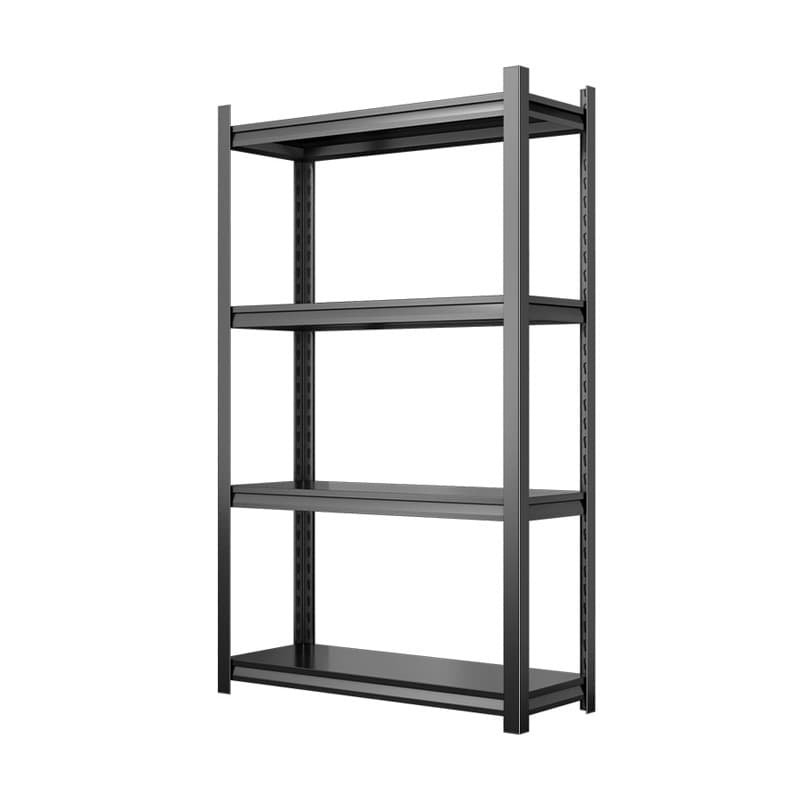
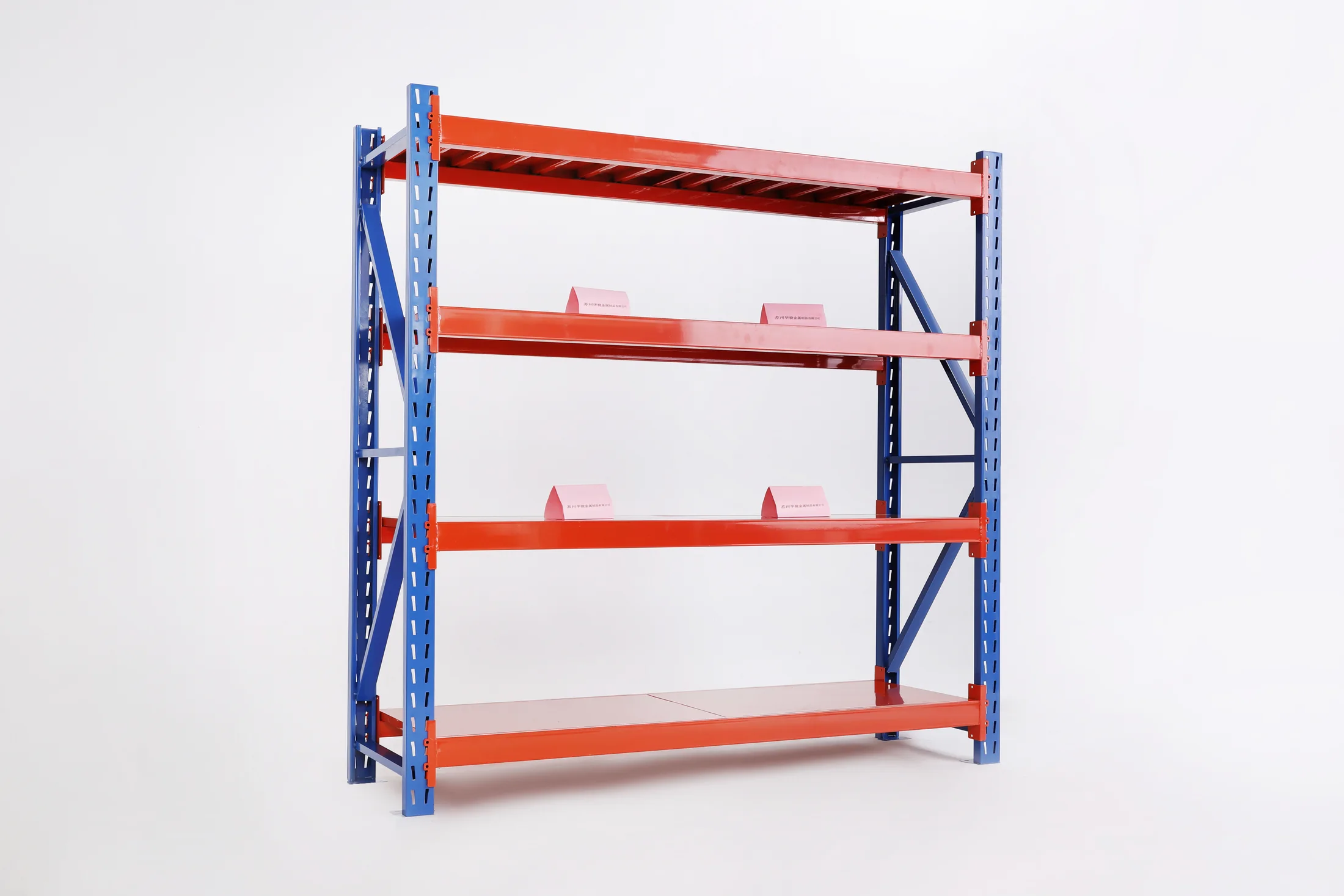
Start with the three bays below — the 100 kg keyhole slotted angle home storage bay, the modular boltless rivet bays, and the 100–500 kg blue-orange medium duty rack — or send your bay sizes and load per tier and get a factory layout and price.
Frequently Asked Questions
Is boltless shelving the same as slotted angle shelving?
As names, yes: \"slotted angle\" describes the upright (angle steel with slots punched at intervals) and \"boltless\" describes the joint (beams drop into the slots and lock under load, with no bolts). Huaxiao's angle-steel bays are both at once. As structures, this guide compares the traditional bolted angle-steel bay — nuts, bolts and corner plates — against the boltless rivet bay, and the two are different bays.
Which holds more, boltless or slotted angle shelving?
Neither name decides the load. The load is decided by the steel, the beam profile, the bay width and how the figure was measured. Huaxiao's boltless range is rated 100 kg per shelf level (standard) and 100–150 kg per level (modular boltless rivet system), per level, evenly distributed. Huaxiao does not sell the old bolted structure and does not publish a rating for it; competitor-published bolted figures run about 45–180 kg per level, which overlaps the boltless range.
Can I convert a bolted angle bay to boltless?
No. The joint is built into the upright and the beam: a bolted bay has bolt holes and corner plates, a boltless bay has keyhole slots and rivet-headed beams. Changing the joint means changing the uprights and the beams — at that point you are buying a new bay.
How much does boltless slotted angle shelving cost, and what is the minimum order?
Slotted angle starts at $12.5 per set and warehouse shelving from $25 per set, per set, with a minimum order of 50 sets. The final price depends on size, tier count, load rating and finish, and is confirmed in the quotation. Production time is 12–22 days, FOB/CIF terms.
Can I move the shelf levels later without tools?
Yes, on a boltless bay: lift the beams out of their slots and drop them into another slot, then re-seat them with a rubber mallet. On a bolted bay the same change means unbolting, moving and re-bolting every joint on that level.
Related Products
Get a Free Layout Design & Quote
Send us your warehouse or store drawings — our engineers will reply within 24 hours with a tailored solution and factory-direct price.