Search "boltless slotted angle shelving" and you get five different answers to the same question. One factory writes 100 kg per shelf level. Another writes 175–500 kg. A third writes 500–1,000 lb. They are not all selling a different product — most of them are selling the same kind of steel bay, and the numbers differ because they are not measured the same way. This guide answers the question the searcher is actually asking: what boltless slotted angle shelving is, why the load numbers disagree, what Huaxiao's own range is rated at, and how to pick a bay without ordering on a number that was never yours. Every Huaxiao figure below is taken from the live product pages. Competitor figures are labelled as competitor-published figures, so you can see where they come from instead of taking them as a second set of Huaxiao numbers. For the load-rating rules in full, see the Warehouse Shelving Load Capacity Guide. For how to pick width, depth, tiers and load bay by bay, see Slotted Angle Shelving Sizes Explained. For what happens to a rating when a shelf is put on wheels, see Static vs on Wheels.
Quick answer
Boltless slotted angle shelving is a steel storage bay built from angle-steel uprights with slots punched at regular intervals. Beams drop into the slots and lock under load — no bolts, no nuts, no special tools. "Boltless", "slotted angle", "rivet" and "keyhole" shelving are names for the same system, not four different products: "slotted angle" describes the upright, "boltless" describes how it goes together.
Huaxiao's standard range is rated 100 kg per shelf level for an evenly distributed load, and the modular boltless rivet system is rated 100–150 kg per level. Both figures are per level, not per bay, and the exact figure for your configuration is confirmed in the quotation. If you need more than 150 kg per level, you are no longer in slotted angle territory — see the Medium Duty Shelving Explained guide.
1. Boltless vs slotted angle: the same bay, two names
The confusion starts with the names, because suppliers use them as if they were different products. They are not.
Two slot styles appear in Huaxiao's range. Inward-facing keyhole slots face into the bay, giving a clean exterior, and are used on the compact 900 mm home and stockroom units. External keyhole (gourd-hole) slots face out, for fast drop-in assembly on the wider commercial units. Both are tool-free. Neither changes the rated load by itself. What changes the load is the bay size, the steel, and how the weight is spread — see section 2.
The practical consequence is simple: when you compare suppliers, compare the same thing. A "boltless" bay rated 100 kg per level and a "slotted angle" bay rated 100 kg per level are the same claim in different words. A bay rated 500 kg per level is a different claim, and section 2 explains how to read it.
| Name | What it describes | What it does not mean |
|---|---|---|
| Slotted angle shelving | The upright: angle steel with slots punched at intervals | It does not say how the beams join — that is the next row |
| Boltless shelving | The joint: beams drop into the slots and lock under load, no bolts | It does not mean a different upright, steel or rating |
| Rivet / keyhole shelving | The slot shape: rivets on the beam heads seat into keyhole slots | It does not mean a heavier or lighter bay by itself |
| Boltless slotted angle shelving | The full system: slotted angle uprights + boltless joints | The search term buyers use when they want both facts at once |
2. Why five suppliers give five different load numbers
A Guangzhou factory's November 2026 guide put it honestly: ask five suppliers and you will get five answers, mostly in the 100–200 kg per level range. That is not a joke about the industry — it is a warning about how the numbers are made. The five most common reasons a published figure is higher than the figure you can actually load:
None of those figures is wrong on its own page. They are wrong only when they are copied onto a different bay as if they were its rating. Huaxiao's answer to the same question is narrower on purpose: standard 100 kg per level, modular 100–150 kg per level, both per level, evenly distributed, confirmed for your configuration in the quotation.
- A test value presented as a rating. A bay loaded once in a test, without damage, is not a bay rated for that load every day. A rating is the load the bay is sold to carry repeatedly, per level, evenly distributed. When a number has no "per level" and no "evenly distributed" next to it, treat it as a test claim, not a rating.
- Per bay presented as per level. A five-tier bay at 100 kg per level holds 500 kg in total. A supplier that writes "500 kg" without saying "per level" may be quoting the whole bay. One level loaded with 200 kg is overloaded even if the other four are empty.
- A wider or thicker bay's number applied to a narrower one. Load falls as bay width rises for the same steel. Huaxiao's standard range uses 1.0–1.2 mm uprights, 1.0–1.5 mm beams and 0.5 mm steel shelf panels (0.5–0.8 mm in the modular rivet system). A figure from a heavier beam profile does not transfer to a lighter one.
- A concentrated load presented as a distributed load. Ratings assume the weight is spread evenly across the shelf (UDL). A single heavy item sitting in the middle of one panel loads it differently. Ask: evenly distributed, or one point?
- The static figure quoted for a mobile bay. Put the same bay on casters and the rating falls — our load guide's finding is that the per-level rating is effectively halved on wheels. A 100 kg static level is not a 100 kg mobile level.
| Source (as found 2026-11-13) | Published figure | Read it as |
|---|---|---|
| Heda industrial shelving guide | 500–1,000 lb per level | A wide range across its whole industrial range, not one bay |
| Dowell (Qingdao) product page | 175–500 kg per level | A specification table across several configurations, with 8 FAQs |
| RacksZone comparison | Boltless 100–500 kg vs slotted angle 100–300 kg per level | A comparison table; the two columns overlap, which is the point — the names are not two load classes |
| Shibang deep guide | 7-system comparison table + step-by-step installation | Useful for the install sequence, not for a single rating |
| Huijian (Guangzhou), 2026-11-06 | "Ask five suppliers, get five answers, mostly 100–200 kg per level"; 150 / 500 / 800 kg tier table | The honest framing: the range is wide because the test conditions are not standard |
3. Huaxiao's load tiers: pick by the heaviest level, not the catalogue photo
Three rules from the load and sizes guides apply here, because this is where buyers get caught: a range is not a promise of its top number — "100–150 kg" does not mean every modular bay carries 150 kg per level, and "100–500 kg" does not mean every medium duty bay carries 500 kg. The exact figure depends on bay width, beam profile and deck, and it is confirmed in the quotation. Width and load do not rise together: in Huaxiao's standard range the 1500 mm commercial bay is rated at the same 100 kg per level as the 900 mm home bay. Do not buy the widest bay for the heaviest goods. The heaviest level decides: weigh the heaviest single load that will sit on one level, check it against the per-level rating, and spread it evenly. Keep the heaviest load low and near the uprights, and make sure every rivet is fully seated.
Standard sizes in this range: 900 × 400 × 1830 mm, 1200 × 450 × 2000 mm, 1500 × 450 × 2000 mm, and a narrow 600 × 300 × 1830 mm unit, in 3, 4, 5 or 6 tiers; the modular system also runs as continuous starter and add-on bays along a wall. Factory terms: minimum order 50 sets, production time 12–22 days, FOB/CIF, black powder coat or customised colour. Custom sizes, tier counts and finishes are made to order, and the final specification is stated in the approved drawing and quotation — not in a catalogue line.
Huaxiao Rack (Suzhou Huaxiao Metal Products Co., Ltd.) has manufactured warehouse and supermarket shelving since 2000, ISO 9001 certified, in Q235B steel. Those credentials are on the About page; they are repeated here because a load figure without a factory behind it is only a number.
| Range | Rated load per shelf level | Best for |
|---|---|---|
| Standard slotted angle (boltless) | 100 kg | Cartons, parts, tools, retail stockroom storage |
| Modular boltless rivet system | 100–150 kg | Continuous multi-bay runs, stockrooms that reconfigure often |
| Medium duty | 100–500 kg | Power tools, bulk hardware, warehouse and stockroom stock |
| Heavy duty | 500–1,000 kg | Heavy warehouse stock and dense parts |
| S50 gondola system | 100–200 kg | Supermarket and retail island display |
4. Standard vs modular: the two Huaxiao boltless configurations
Within Huaxiao's boltless range there are two configurations, and the names are the first thing to get straight: "slotted angle" and "boltless" are not two different products. "Slotted angle" describes the upright — angle steel with slots punched at intervals. "Boltless" describes the joint — beams drop into the slots and lock under load, with no bolts. Both configurations below use the same boltless principle. What differs is the steel, the rating and how the bays join into runs.
The standard bay is the single-bay workhorse: 100 kg per shelf level, 0.5 mm steel shelf panels, in 3, 4, 5 or 6 tiers. The modular rivet system is the heavier, reconfigurable version: 100–150 kg per shelf level, 0.5–0.8 mm shelf panels, and it runs as continuous starter and add-on bays along a wall instead of single bays. The exact figure for your configuration is confirmed in the quotation — a range is not a promise of its top number.
| Standard slotted angle | Modular boltless rivet system | |
|---|---|---|
| Rated load per shelf level | 100 kg | 100–150 kg |
| Shelf panel steel | 0.5 mm | 0.5–0.8 mm |
| Bay sizes | 900 × 400 × 1830 / 1200 × 450 × 2000 / 1500 × 450 × 2000 mm; narrow 600 × 300 × 1830 mm | 900 × 400 × 1830 / 1200 × 450 × 2000 mm |
| Tiers | 3 / 4 / 5 / 6 | 4 / 5 / 6, or continuous runs |
| Runs | Single bays | Continuous starter and add-on bays along a wall |
| Best for | Home pantry, garage, light stockroom; commercial stockroom | Continuous multi-bay runs, distribution hubs, stockrooms that reconfigure often |
5. Installation: tool-free, in minutes — watch it before you order
Assembly is the part of "boltless" that is easiest to verify and hardest to fake: there are no bolts to lose and no spanner to find.
Our 35-second installation video shows the whole sequence on a real bay — watch it below before you order. The video's on-screen load figure is 100 kg per tier, matching the standard rating.
- Lay out and check the parts. Four uprights, beams, steel shelf panels, and feet or casters if ordered. Check the beam rivets and the slot spacing before you start — a bay that starts with the wrong beam will not sit level at the end.
- Build the first level low. Seat the beams for the lowest level into the upright slots and tap them home with a rubber mallet. The beams lock under load; a beam that is not fully seated will rock.
- Work upward, one level at a time. Add each level's beams and panels before moving to the next. Keep the uprights plumb with a level as you go — a bay that leans at level two leans more at level five.
- Re-pitch before you load, not after. Shelf levels can be moved later without tools, but set the heights for your tallest item first: measure the tallest product, add hand clearance, and only then count tiers.
- Load heaviest low, spread evenly. Put the heaviest items on the lowest levels, near the uprights, spread across the panel — never all in the middle of one level. On casters, use the mobile rating, not the static one.
Watch it in action
See the installation on video
The 35-second installation on a real bay — watch it on our YouTube channel, no account needed.
6. What to ask the factory before you order
On price: slotted angle starts at $12.5 per set, warehouse shelving from $25 per set, supermarket gondola from $23 per set, all per set, minimum order 50 sets. Those are category starting prices — the final price for your bays depends on size, tier count, load rating and finish, and is confirmed in the quotation.
- Heaviest load per level (kg), and is it evenly distributed?
- Largest carton / item dimensions (length × width × height)
- Required bay size, depth and number of tiers
- Starter bays, add-on bays, or a continuous run?
- Floor area, clear height, and aisle width available
- Colour / finish required, and any branding
- Quantity, delivery destination, and FOB or CIF terms
Conclusion
Boltless slotted angle shelving is one system with two names: slotted angle uprights, boltless joints, no tools. The load numbers disagree across suppliers because they are measured differently — test values, per-bay totals, heavier profiles and static figures quoted for mobile bays. Huaxiao's range is rated 100 kg per level standard and 100–150 kg per level modular, per level, evenly distributed, with medium duty at 100–500 kg and heavy duty at 500–1,000 kg above that. Pick by the heaviest thing on one level, confirm the exact figure for your configuration in the quotation, and watch the 35-second installation before you order.
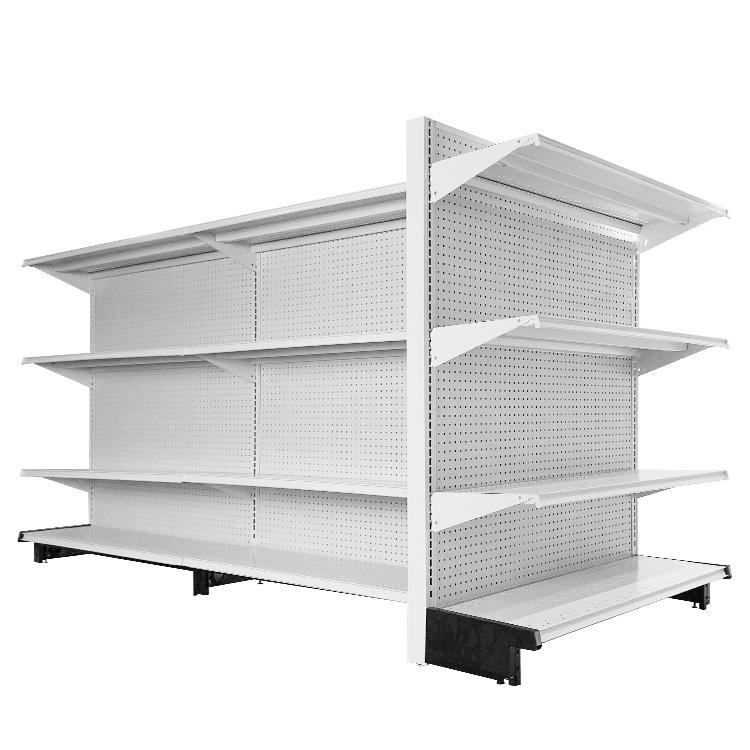
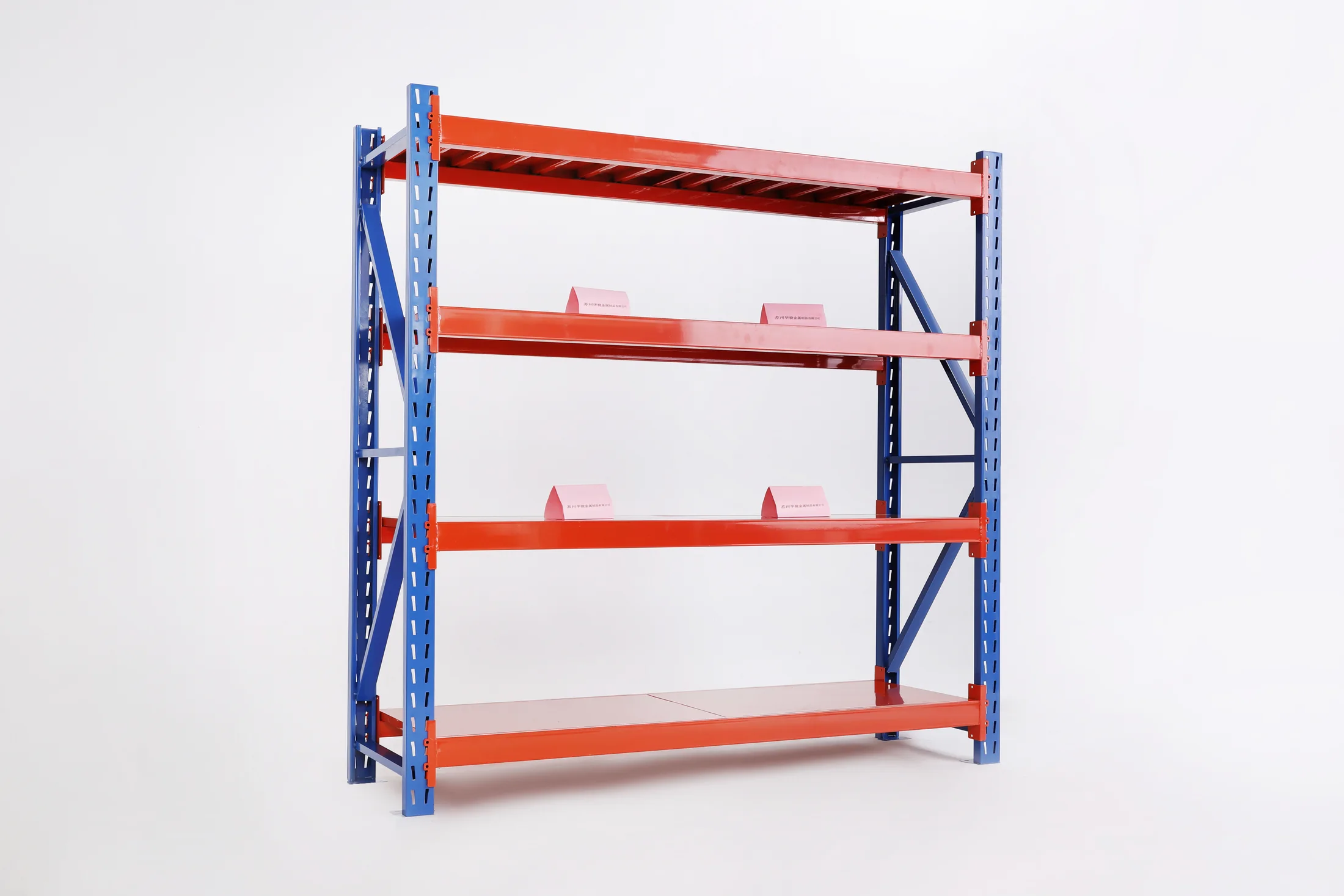
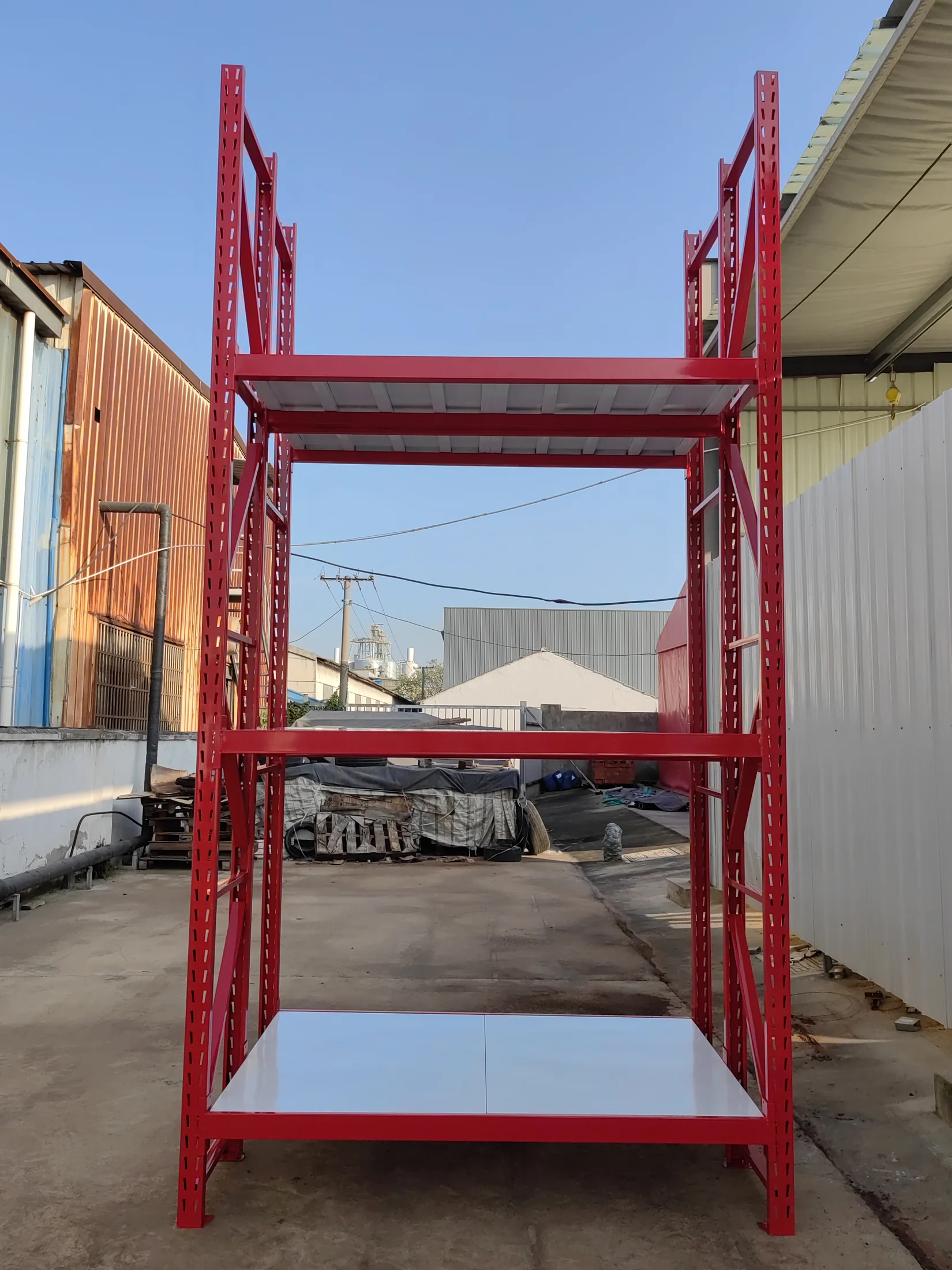
Start with the three bays below — Slotted Angle Shelving, Boltless Shelves, the 100–500 kg blue-orange medium duty rack and the 500–1,000 kg heavy-duty rack — or send your bay sizes and load per tier and get a factory layout and price.
Frequently Asked Questions
What is boltless slotted angle shelving?
A steel storage bay built from angle-steel uprights with slots punched at regular intervals. Beams drop into the slots and lock under load, so the bay goes up without bolts, nuts or special tools. "Boltless", "slotted angle", "rivet" and "keyhole" are names for the same system.
How much weight can boltless slotted angle shelving hold?
In Huaxiao's range, the standard version holds up to 100 kg per shelf level and the modular boltless rivet system holds 100–150 kg per level, both for an evenly distributed load. For loads above 150 kg per level, use medium-duty (100–500 kg per level) or heavy-duty (500–1,000 kg per level) shelving instead. Always confirm the figure for your exact configuration in the quotation.
Why do different suppliers quote different load capacities?
Because the numbers are not measured the same way: a one-off test value presented as a rating, a whole-bay total presented as a per-level figure, a heavier beam profile's number applied to a lighter bay, a concentrated load presented as a distributed load, or a static figure quoted for a bay on casters. Ask every supplier the same question — per level, evenly distributed, for this exact configuration?
Can I assemble it without tools?
Yes. Beams drop into the slotted uprights and lock under load, so a bay goes up with a rubber mallet and a level, and shelf levels can be re-pitched later without tools.
What sizes are available?
Standard bays include 900 × 400 × 1830 mm, 1200 × 450 × 2000 mm, 1500 × 450 × 2000 mm and a narrow 600 × 300 × 1830 mm unit, in 3, 4, 5 or 6 tiers. The modular system also runs as continuous starter and add-on bays. Other sizes are made to order.
What is the minimum order and lead time?
Minimum order is 50 sets, production time 12–22 days, FOB/CIF terms. Custom OEM sizes are available.
Is boltless shelving the same as rivet shelving?
Yes. "Rivet" and "keyhole" describe the slot shape: rivets on the beam heads seat into keyhole slots in the uprights. "Boltless" describes how the bay goes together — beams drop into the slots and lock under load, with no bolts. They are names for the same system, not different products.
Can I reconfigure boltless shelving later?
Yes. Shelf levels can be re-pitched later without tools — measure the tallest item, add hand clearance, and move the levels. The modular boltless rivet system is built for stockrooms that reconfigure often, running as continuous starter and add-on bays.
Related Products
Get a Free Layout Design & Quote
Send us your warehouse or store drawings — our engineers will reply within 24 hours with a tailored solution and factory-direct price.